The TEACH-AI Decision Framework™
A Practical Guide to Responsible AI Use in Education
Artificial Intelligence is rapidly becoming part of everyday teaching. Educators can now use AI to develop instructional materials, generate ideas, prepare assessments, draft communications, differentiate learning activities, and streamline administrative work.But the most important question for educators is no longer simply:
“Can AI do this task?”
A more important professional question is:
“Should AI do this task—and how much responsibility should remain with the teacher?”
The TEACH-AI Decision Framework™, developed as part of the professional learning initiatives of PinoyPrint AI Academy, provides educators with a practical way to think before delegating educational work to Artificial Intelligence.
Rather than treating AI as either something to embrace completely or avoid entirely, the framework encourages purposeful, ethical, and human-centered decision-making.
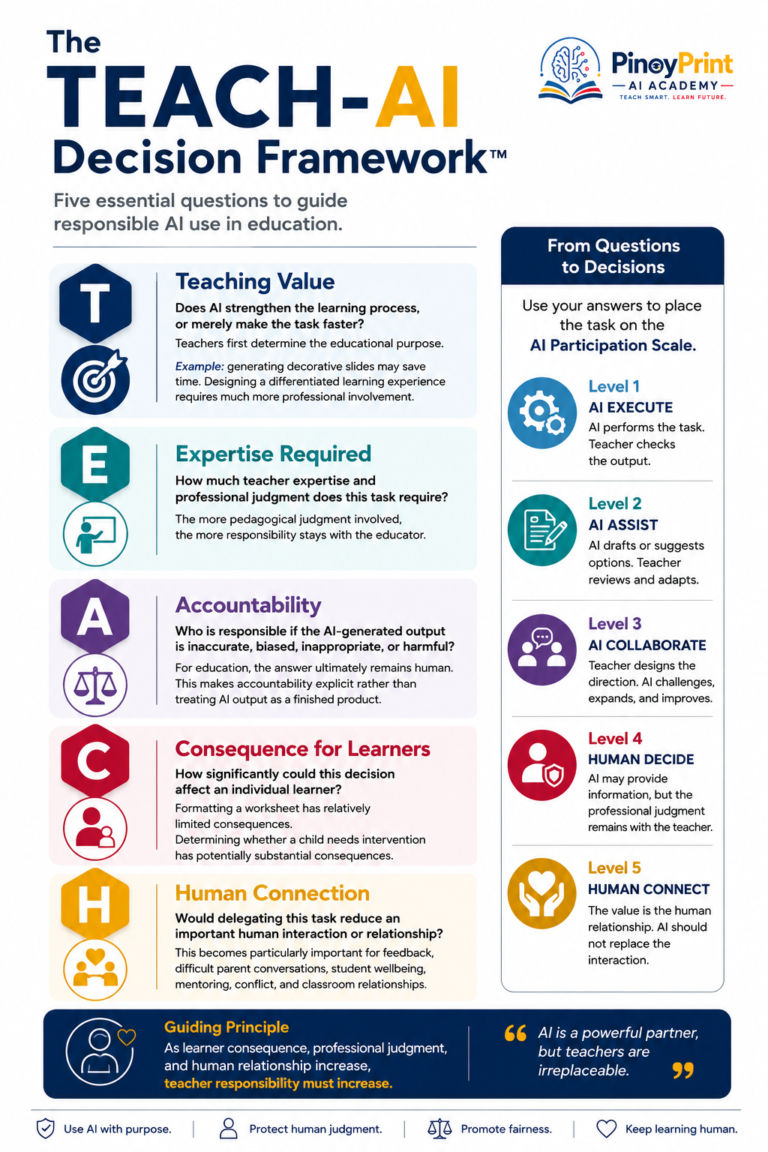
What is the TEACH-AI Decision Framework™?TEACH-AI is built around five questions educators can ask before using AI for a teaching or professional task.T — Teaching Value
Does AI strengthen the learning process, or merely make the task faster?
Efficiency alone should not determine whether AI belongs in an educational activity. Teachers should first identify the instructional purpose and determine whether AI contributes meaningfully to learning.
For example, using AI to convert completed content into presentation slides may primarily save time. Designing a differentiated learning experience, however, involves pedagogical decisions that require considerably greater teacher involvement.
The first question therefore brings the focus back to learning rather than technology.E — Expertise RequiredHow much teacher expertise and professional judgment does this task require?
Not every teacher task carries the same level of professional judgment.Routine formatting and administrative work may require relatively little pedagogical expertise.
Lesson sequencing, differentiation, assessment design, intervention planning, and evaluation require considerably more.As the amount of professional expertise required increases, teacher involvement should also increase.
AI may contribute suggestions, alternatives, or information, but it should not become a substitute for professional expertise.
A — AccountabilityWho is responsible if an AI-generated output is inaccurate, biased, inappropriate, or harmful?AI can generate highly convincing information that may still contain errors, inappropriate recommendations, unsupported claims, or bias.
For educators, accountability cannot simply be transferred to the technology.Teachers must remain able to explain the decisions they make, verify information they use, and take responsibility for materials and communications they provide to learners.
AI may generate the output. The educator remains accountable for its use.C — Consequence for LearnersHow significantly could this decision affect an individual learner?
The consequences of AI-assisted tasks vary substantially.Formatting a worksheet carries relatively limited consequences. Writing personalized feedback has greater implications. Determining whether a learner requires intervention, evaluating academic performance, or making decisions affecting a student's progression carries significantly greater consequences.
The TEACH-AI Framework therefore proposes an important principle:The greater the consequence for the learner, the greater the level of human responsibility required.Technology can provide information and support analysis, but consequential educational decisions require professional judgment.H — Human Connection
Would delegating this task reduce an important human interaction or relationship?Teaching is fundamentally relational.Feedback, mentoring, encouragement, sensitive parent communication, student wellbeing, conflict resolution, and classroom relationships depend upon understanding context, emotion, culture, personality, and individual circumstances.
AI can sometimes help teachers prepare for these interactions, but it should not replace the human relationship that gives them meaning.Teachers should therefore consider not only whether AI can perform a task, but whether delegating the task would remove something important from the educational relationship.
Suggested keywords: TEACH-AI Framework, AI for teachers, AI in education, responsible AI in education, artificial intelligence for educators, teacher AI framework, human-centered AI, AI teacher training, ethical AI for teachers, AI professional development.